
Key Takeaways
Run parallelization, executing many automation runs concurrently rather than one after another, is presented as a cornerstone of both speed and scalability, which increasingly determine competitive advantage for automation platforms. Borrowing from parallel computing, where instructions are split into smaller parts and run at the same time across multiple processors, the post notes this principle has never been effectively applied to traditional RPA. The illustrative math is stark: a single bot processing 100 month-end invoices at five minutes each cannot finish them within an eight-hour workday when run sequentially. Kognitos’ concurrent processing engine brings true parallelism to enterprise automation, running those workloads simultaneously to collapse processing time and remove persistent bottlenecks. The business impact is faster cycle times and the ability to scale high-volume processes that sequential automation simply cannot keep up with. Learn more on the Kognitos platform.
Automation platforms are becoming increasingly more sophisticated with the introduction of AI agents. In fact, even incumbent robotic process automation (RPA) tools are seeking to pivot toward an agentic automation offering through product development and strategic acquisitions.
Speed and scalability often determine competitive advantage for automation platforms, and the ability to run parallel processing is a cornerstone of both. This blog explores run parallelization, parallel or concurrent processing in automation, and its implications on the enterprise.
What is Run Parallelization?
Parallelization is a foundational requirement for modern computing, enabling software to run multiple tasks at the same time, or in parallel, to avoid persistent bottlenecks. Parallel computing allows each step of a process to execute at the same time, rather than sequentially. This diagram from Lawrence Livermore National Laboratory breaks it down:
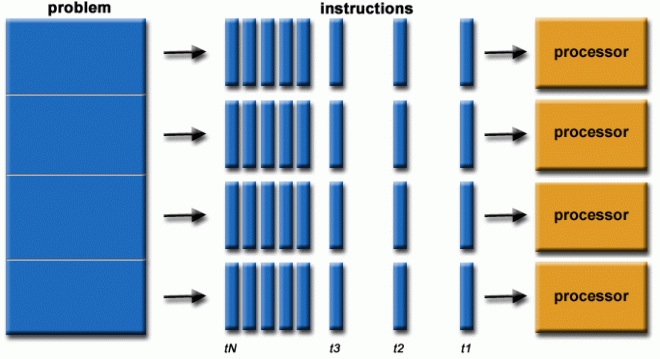
In this example, rather than running each instruction one after the other, the instructions are divided into smaller parts that are run concurrently using multiple processors. This concept of parallelization has not effectively been applied to traditional forms of automation including robotic process automation (RPA). Kognitos is now bringing the benefits of parallel processing to automation.
Kognitos’ Concurrent Processing Engine
Kognitos is redefining enterprise automation with its parallel processing capabilities. For example, take the common use case of invoice processing. In a traditional RPA environment with a single bot processing invoices, they are run sequentially. For this example, let’s assume that at month-end, there are 100 invoices to process. Each invoice takes 5 minutes to complete. Simple math would dictate that not all of these invoices could be processed in an 8-hour workday.
100 invoices x 5 minutes per invoice = 500 minutes or 8 hours and 20 minutes
Kognitos, on the other hand, is capable of not only breaking down complex documents into smaller, more manageable snippets (parallelization), but also running up to 5,000 processes concurrently with little to no latency increase.
Let’s illustrate this with a concrete scenario similar to the RPA invoice example above. In this instance, month-end invoice processing consists of 100 invoices that have been combined into a single PDF. The Kognitos platform is capable of first breaking down the PDF into 100 separate invoices, then running all of those invoices concurrently. In this example, for comparison’s sake, let’s assume that it also takes the Kognitos platform 5 minutes to process an invoice.
100 invoices x 5 minutes per invoice running concurrently = 5 minutes
Not only do processes run concurrently, parallelization is built into the platform, allowing each stage of the hyperautomation lifecycle to run at the same time. So, while Kognitos is auto-writing new automations, it is simultaneously auto-debugging that same workflow, while also auto-monitoring performance and health of all automations. This is achieved through a serverless infrastructure that dynamically allocates resources without expensive bots.
Business Impact
Parallelization and concurrent processing should be table stakes for AI automation, but has remained a sore spot for RPA and similar traditional automation tools like intelligent document processing (IDP).
Kognitos’ ability to run concurrent processes and incorporate parallelization directly into the platform is a paradigm shift for organizations seeking an enterprise-scale AI automation solution. If you’re looking for an efficient and scalable automation solution, reach out to the Kognitos team today, or sign up for our community version to try it out for yourself.
How to Implement Parallel and Concurrent Processing in Enterprise Automation
- Identify the bottleneck steps in current sequential automation workflows. Most enterprise automation workflows execute sequentially even when steps are independent. Map the workflow and identify steps that have no dependency on prior step outputs. These are parallelization candidates.
- Design the parallel processing architecture for independent workflow steps. Parallel processing architecture requires defining: what processing can run concurrently, how the results are assembled after parallel steps complete, and what error handling applies when one parallel step fails.
- Test parallel processing throughput with production-representative volume. Parallel processing performance must be tested at production-representative transaction volumes. A parallel workflow that performs well at 100 transactions per hour may encounter resource constraints at 10,000 transactions per hour. Load test before go-live.
- Configure exception handling for parallel processing failures. When one step in a parallel workflow fails, the behavior of the other parallel steps must be defined: continue independently, pause for the failed step to recover, or fail the entire batch. Define this behavior explicitly before deployment.
- Measure throughput improvement and processing time reduction. Track transactions per hour and average processing time before and after parallel processing deployment. Throughput improvement is the primary metric for parallelization investments.