A bank’s moat is trust.Hold your AI agents to the same standard.
Automate banking workflows with approved English business rules and results your team can inspect. Keep the finding, its evidence and the next action together.
↳Judgment stays with people. A finding supports the reviewer’s next step.
Dependable operations
Put approved policies at the center of the work.
Capacity for clients
Focus your evaluation on time spent gathering evidence and handling rework.
Controlled change
Turn business knowledge into procedures your team can review.
Recognized by Leading Analysts
The work. The rules. The evidence.What can banks automate with Kognitos?
English as Code
Kognitos is a neurosymbolic AI platform for banking workflow automation. The demonstrations below show cash structuring and currency transaction reporting (CTR) review, and card dispute investigations.
AI helps plan the work. Approved English rules govern execution. People can inspect the results and the recommended follow-up.
Which cash activity needs a closer look and why? Start with the finding, then inspect the transactions and rules behind it. This Kognitos cash review run separates different kinds of work. Its summary lists amounts for currency transaction reporting and identifies other activity above the threshold as exempt. Follow the $12,500 amount. The next questions are concrete: which transactions contribute to it, which business day is being reviewed, and how are the records grouped? The run includes steps for daily aggregation and exemptions. It separately checks for near-threshold series, same-day splits, and activity on consecutive days. Those checks serve different purposes. A reporting threshold and a possible structuring pattern are not the same. Finding a pattern calls for review; it does not establish criminal intent. Keep the finding, its supporting evidence, and the next action together so the responsible reviewer can understand what needs attention. Kognitos’s neurosymbolic platform separates AI planning from deterministic execution. Approved English business rules govern the work with results people can inspect. Start with one cash review workflow on your existing systems. Visit kognitos.com to explore the platform and book a demo.
Follow the reported amount
Inspect which transactions contribute, the business day under review and how records are grouped.
Inspect the rules behind the finding
The run includes daily aggregation and exemptions, plus separate checks for near-threshold series, same-day splits and consecutive-day activity.
Keep reporting and pattern review distinct
A reporting threshold and a possible structuring pattern answer different questions.
The review boundary: A pattern calls for review. It does not establish criminal intent.
Kognitos for Banking02 / Card dispute investigation
Two unrecognized charges.Two different follow-ups.
Bring case details, a finding and a recommended next step into a report the investigator can inspect.
Two customers report an unrecognized charge. Why might the findings differ? Bring the evidence together and inspect the reason behind each assessment. This Kognitos run produces two separate investigation reports. Each keeps its case details, finding, and recommended next step together. Start with the credit card case. The report marks it likely fraud and recommends investigating it as unauthorized. Its explanation says the checks found no signal that the customer made the charge. Now compare the separate debit card case. This report says recognized descriptor. The name on the statement resolves to a merchant the customer uses. Its next step is to confirm that with the customer. That is a different assessment and a different follow-up. Merchant familiarity alone does not settle whether a charge was authorized. Inspect the transaction details and the reasoning behind the finding. Keep the customer’s report in view and keep an investigation recommendation distinct from a refund or final case decision. Kognitos’s neurosymbolic platform separates AI planning from deterministic execution. Approved English business rules govern the work with results people can inspect. Start with one card dispute workflow on your existing systems. Visit kognitos.com to explore the platform and book a demo.
Credit card case: “likely fraud”
The report says its checks found no signal that the customer made the charge. It recommends investigating it as unauthorized.
Debit card case: “recognized descriptor”
The statement name resolves to a merchant the customer uses. The recommended next step is to confirm that with the customer.
Inspect each case on its own evidence
Merchant familiarity alone does not settle whether a charge was authorized.
The review boundary: An investigation recommendation is distinct from a refund or final case decision.
Kognitos for BankingHow Kognitos works
How does Kognitos automate banking work?AI plans. Approved rules execute.
A neurosymbolic platform connects AI planning with deterministic execution.
Cash review · illustratedRunningComplete
The process, in plain English
“Review the business day’s cash activity. Aggregate it, apply the exemptions, then check separately for near-threshold series, same-day splits and activity on consecutive days. Keep each finding with its evidence for the responsible reviewer.”
Deterministic run
01Aggregate cash activity by business day
02Apply the exemptions
03Check for near-threshold series
04Check for same-day splits
05Check for activity on consecutive days
06Send findings and evidence to the reviewer
Findings ready for reviewEvery step logged
01 / PlanUnderstand the work
Use AI to interpret requests and help draft the procedure.
02 / ApproveMake the rules explicit
Review the English business rules and define the workflow’s authority.
03 / ExecuteRun approved logic
Execute the approved business rules deterministically, with results people can inspect.
04 / ReviewKeep people accountable
Bring findings, evidence and recommended follow-up to the responsible reviewer.
Deterministic execution follows approved logic. Source data and model-derived inputs still need appropriate validation.
“Kognitos helped us eliminate 3,300 hours of manual work per year. Their team understood the human element of AI, and it has been a fantastic partnership that’s helping us grow faster and more efficiently. I absolutely would recommend them.”
Catalog examples are starting points. Banking procedures need to be adapted to your policies and tested before deployment.
Questions worth asking
Before you putAI to work.
Practical answers for banking operations and control teams.
What is Kognitos for Banking?
Kognitos is a neurosymbolic platform that helps banking teams automate operational workflows using approved English business rules and inspectable results. The demonstrations on this page show cash review and card dispute investigations, with findings, supporting evidence and recommended next steps kept together for review.
How can AI support cash structuring and CTR review?
The cash-review demonstration includes daily aggregation and exemption checks, alongside separate checks for near-threshold series, same-day splits and activity on consecutive days. A currency transaction reporting threshold and a possible structuring pattern serve different purposes. A pattern calls for review; it does not establish criminal intent. This is a US reporting example, and the rules and review boundaries must be agreed for your workflow.
How can AI help investigate card disputes?
Kognitos can help bring case details, findings and recommended next steps together for investigators. The demonstration compares two separate cases: a credit card report marked likely fraud and a debit card report with a recognized merchant descriptor. Merchant familiarity alone does not establish authorization. An investigation recommendation is distinct from a refund or final case decision.
What does deterministic execution mean here?
Kognitos separates AI planning from deterministic execution. Approved English business rules govern the work, with results people can inspect. Deterministic execution follows the approved logic; it does not make incorrect source data or model-derived inputs correct. Those inputs still need appropriate validation.
Who decides what the workflow may do?
Define the workflow’s authority and escalation boundaries with its business and control owners. In the demonstrations, findings and recommended follow-up support a responsible reviewer. The cash review is not a finding of criminal intent, and the dispute investigation is not a final refund or claim decision.
Can we start with our existing systems?
Start by selecting one workflow and identifying its source systems, data, approved rules and review requirements. Confirm the integrations and permissions needed during scoping. Banking procedures need to be adapted to the bank’s policies and tested with representative cases before expanding the workflow.
How should we evaluate the first workflow?
Agree on a baseline and acceptance criteria before the evaluation. Measure review time, manual touches, correct completion against reviewed cases, evidence completeness and the time needed to reconstruct a finding. Expand only after the business, technology and control owners accept the results.
Your rules. Your reviewers.A workflow you can stand behind.
Bring a banking process your team wants to improve. Together, define the rules, review boundaries and evidence of success. To see how banks take AI into production, watch our AI in Banking webinar (November 18, 2026).


 Demo guide


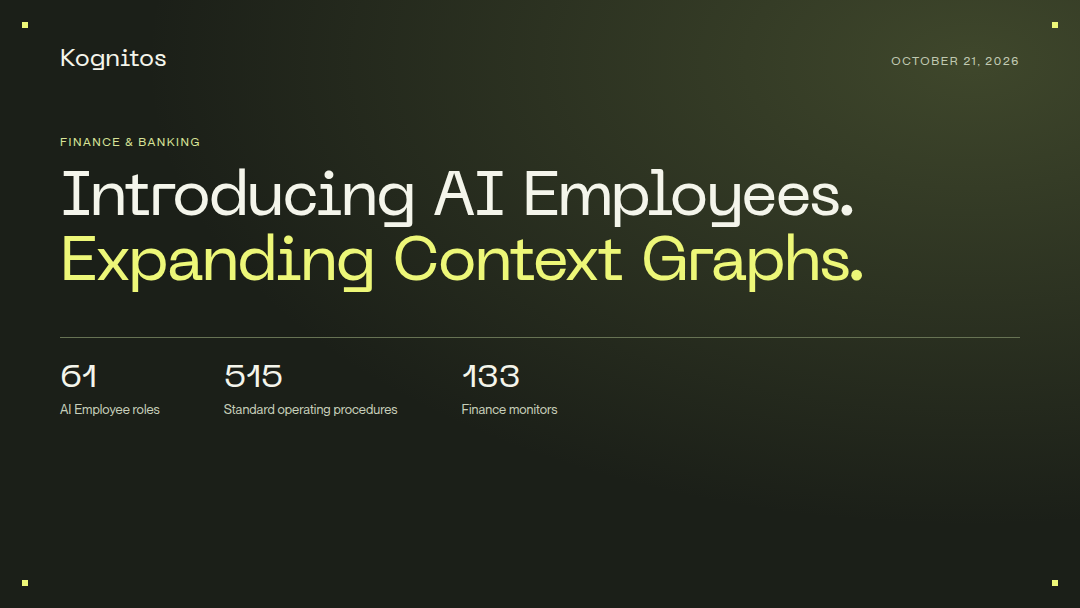 Product news · October 21, 2026Kognitos launches AI Employees and expands Context Graphs for finance and banking


