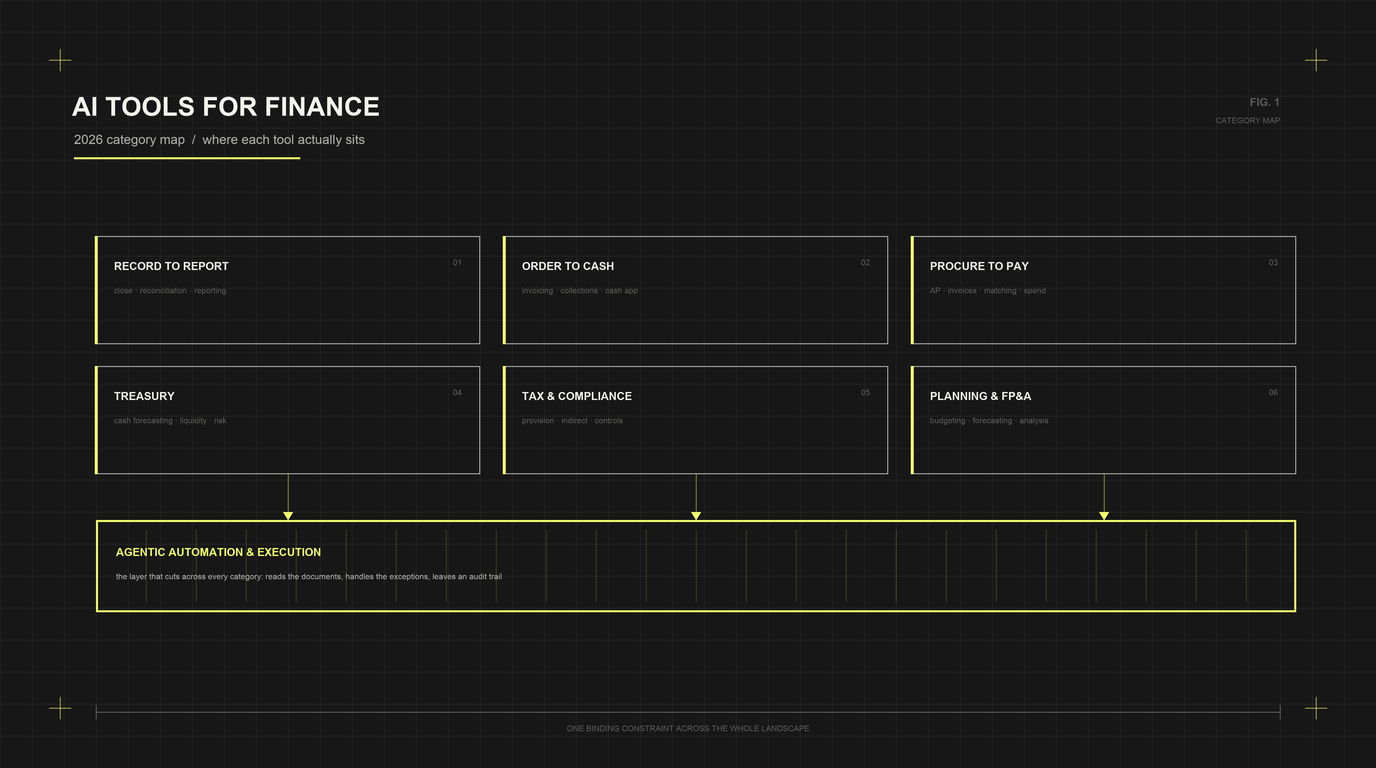
Every finance and accounting tool now claims to be AI-powered, every ERP vendor and startup is claiming the agentic category, and the noise makes it genuinely hard to tell what each tool actually does and where it fits. This is a map, not a ranking: it organizes the 2026 finance-and-accounting AI landscape into clear categories, explains what each category does and who the representative players are, and shows how the categories relate, so you can locate any tool and understand the shape of the whole landscape before evaluating individual products.
TL;DR
The finance and accounting AI landscape in 2026 is large and noisy, but it organizes into a manageable set of categories. Rather than one ranked list, this map lays out the categories, what each does, and representative players, so you can orient before evaluating specific tools.
The core categories: core accounting and bookkeeping; accounts payable automation (invoice-to-pay); accounts receivable and order-to-cash; financial close and reconciliation; FP&A and planning; treasury and cash management; spend and expense management; tax and compliance; audit and controls; and technical accounting. Cutting across all of these is the agentic automation and execution layer, the platforms that read unstructured data, reason about exceptions, and execute work across the other categories.
Two organizing ideas make the map useful. First, most categories split into a system-of-record or specialist-engine layer and an execution-and-exception layer that feeds and operates on it, and the distinction matters because that is where much of the manual work and the AI opportunity actually sits. Second, the binding constraint across finance is usually data quality and consistency across systems, not processing speed, so the tools that validate, reconcile, and enforce policies across source systems address the actual problem, while tools that only move data faster do not.
The market context: adoption is high (Gartner found 58% of finance functions using AI in 2024, up 21 points year over year, and projects most will deploy at least one AI solution by 2026), but realized impact is uneven (only about 7% of CFOs report strong impact so far), and McKinsey estimates 42% of finance activities are fully automatable with another 19% mostly automatable, so the opportunity is large but execution-dependent.
This post maps each category, names representative players, and shows how the layers fit. For the agentic-platform-specific ranking, see The 10 Best Agentic AI Platforms for Finance Automation.
How to read this map
Before the categories, three framing ideas that make the landscape legible.
First, categories are defined by the finance function they serve, not by the technology. "AI for finance" is not one market; it is a dozen adjacent markets (AP, AR, close, FP&A, tax, treasury, and so on), each with its own tools, and a tool is best understood by which function it serves. The map is organized this way because that is how finance teams actually evaluate: by the problem they are solving.
Second, most categories have two layers. There is usually a system of record or specialist engine, the ERP that holds the ledger, the tax engine that computes tax, the lease engine that does ASC 842, the FP&A platform that holds the plan, and there is an execution-and-exception layer that feeds data into it and handles the work it cannot. The specialist engines are mature; much of the remaining manual work, and much of the AI opportunity, lives in the execution-and-exception layer that assembles the data, handles the exceptions, and operates across systems. Keeping this distinction in mind prevents the common error of assuming the engine does everything.
Third, the binding constraint is usually data quality, not speed. The recurring lesson across finance AI is that most finance failures are not caused by slow data movement but by data that is wrong, incomplete, or inconsistent across systems. Tools that merely move data faster do not fix that; tools that validate, reconcile, and enforce policies across source systems do. This is why the agentic execution-and-validation layer that cuts across the categories matters as much as the category-specific tools, and it is a useful lens for judging whether a tool addresses the real problem.
With those in mind, here is the map.
The categories
Core accounting and bookkeeping
What it is: The foundation, the general ledger, chart of accounts, and the recording of transactions, plus the automation of bookkeeping and journal entries. This is the system of record everything else feeds and draws from, and it is the layer where the labor projections diverge: bookkeeping clerks are projected to decline while accountants and auditors grow.
Representative players: The ERPs and accounting platforms, NetSuite, SAP, Oracle, Microsoft Dynamics, Sage Intacct at the enterprise and mid-market level, and cloud accounting platforms (QuickBooks, Xero, and regional leaders) for smaller businesses, increasingly adding AI for automatic journal-entry classification and document-to-entry automation.
Where AI fits: Automating the classification and entry of transactions from source documents (bank statements, invoices), suggesting journal entries, and reducing manual bookkeeping. The frontier is moving from input assistance toward agents that process entries autonomously.
Accounts payable automation
What it is: The invoice-to-pay process, capturing, extracting, matching, coding, approving, and paying supplier invoices.
Representative players: Dedicated AP automation platforms and AP modules within ERPs and spend platforms, plus agentic AP specialists. Covered in depth in Accounts Payable Automation: The 2026 Guide.
Where AI fits: Reading invoices in any format, matching to POs and receipts, coding (especially non-PO invoices), routing approvals, and, most valuably, handling the exceptions, non-PO invoices, mismatches, that cause AP touchless rates to plateau. The exception-and-reasoning work is where the remaining value concentrates.
Accounts receivable and order-to-cash
What it is: The revenue-side cycle, invoicing customers, collections, and cash application (matching incoming payments to invoices).
Representative players: AR automation and order-to-cash platforms (HighRadius, Billtrust, Versapay, Esker, and others), plus agentic specialists for the exception work. Covered in Order-to-Cash Automation: The 2026 Guide and the AR automation comparison.
Where AI fits: Automating collections prioritization and, critically, cash application, matching messy remittances, short payments, deductions, and lump-sum payments, which is the AR exception work that stalls touchless rates and traps cash as unapplied receivables.
Financial close and reconciliation
What it is: The period-end close, account reconciliations, journal entry review, consolidation, and the production of financial statements.
Representative players: Close and reconciliation platforms (BlackLine, and others), consolidation tools, and reconciliation-focused specialists, increasingly with AI for anomaly detection, summarization, and matching. Related coverage in The Best AI Reconciliation Software for Mid-Market Finance Teams.
Where AI fits: Automating reconciliations (matching records across systems), flagging anomalies, generating workpapers as evidence accumulates rather than at period-end, and continuously reconciling rather than scrambling at close. The value depends heavily on the quality and consistency of the data being reconciled across systems.
FP&A and financial planning
What it is: Budgeting, forecasting, planning, and variance (flux) analysis, the forward-looking and analytical side of finance.
Representative players: FP&A and planning platforms (Anaplan, Workday Adaptive Planning, Pigment, Planful, and others), plus BI tools (Tableau, Power BI) at the analytical layer and newer AI-native analytics tools. Related coverage in AI for Variance Analysis.
Where AI fits: Automating data aggregation, generating forecasts, explaining variances (the "why" behind the numbers), and producing planning narratives. As with forecasting generally, accuracy is gated by the quality of the underlying data more than by the sophistication of the model.
Treasury and cash management
What it is: Liquidity management, cash forecasting, payments, FX and risk, and bank connectivity, the management of the company's cash and financial risk.
Representative players: Treasury management systems (Kyriba, GTreasury, FIS, and others) and modern cash-forecasting and liquidity platforms (Trovata, Nilus, and others). Covered in The Best AI Tools for Treasury and Liquidity Management.
Where AI fits: Cash forecasting, liquidity optimization, payment fraud detection, and anomaly detection. The accuracy of treasury AI, especially forecasting, depends on clean, current data from AR, AP, and bank sources, which is a data-layer problem beneath the TMS.
Spend and expense management
What it is: Travel and expense (T&E), corporate cards, and procurement spend management, controlling and processing what the organization spends.
Representative players: Spend-management platforms (Ramp, Brex, Coupa, SAP Concur, and others) combining cards, expense automation, and spend controls, increasingly with AI for receipt processing, policy checking, and anomaly detection.
Where AI fits: Automating receipt and expense processing, checking expenses against policy, detecting anomalies and fraud, and streamlining approvals. Much of the value is in consistent policy enforcement and exception handling.
Tax and compliance
What it is: Direct tax (corporate tax, provision), indirect tax (sales tax, VAT, GST), and increasingly e-invoicing and real-time tax reporting compliance across jurisdictions.
Representative players: Tax engines and compliance platforms (ONESOURCE, Vertex, Avalara, Sovos, and others) that compute tax and manage filings and e-invoicing. Covered in AI for Corporate Tax and Provision Automation and Agentic AI for Indirect Tax.
Where AI fits: The engines compute the tax; AI adds value in assembling and reconciling the source data the tax calculation depends on (the binding constraint, especially for multi-jurisdiction indirect tax and provision), and in managing the growing e-invoicing and real-time reporting mandates.
Audit and controls
What it is: Internal and external audit, control testing, compliance monitoring, and the governance of financial processes.
Representative players: Audit automation platforms (MindBridge for full-population analysis, DataSnipper for audit evidence in Excel, and others) and controls and compliance monitoring tools. Related governance coverage in AI Audit Trail Requirements and 5 SOX Compliance Risks When Using Generative AI.
Where AI fits: Analyzing full transaction populations (rather than samples) to surface risk, extracting and cross-referencing audit evidence, testing controls, and monitoring for anomalies, with auditability and explainability of the AI itself now a governance requirement under COSO, PCAOB, and SEC scrutiny.
Technical accounting
What it is: Specialized accounting areas with their own standards and complexity, notably revenue recognition (ASC 606) and lease accounting (ASC 842).
Representative players: Revenue recognition engines (Zuora Revenue, RightRev, and ERP revenue modules) and lease accounting engines (LeaseQuery/FinQuery, Visual Lease, Nakisa, Trullion, and others). Covered in AI for Revenue Recognition and ASC 606 Automation and AI for Lease Accounting and ASC 842 Compliance.
Where AI fits: The engines perform the standard-specific calculations; AI adds value in assembling and reconciling the source data (contract data for revrec, lease data for ASC 842) and handling the modifications and events that are the most error-prone part, which is upstream of the engine's calculation.
The layer that cuts across every category: agentic automation and execution
The categories above are the functional areas of finance. Cutting across all of them is a horizontal layer that is the defining development of 2026: agentic automation, platforms that read unstructured data, reason about exceptions, and execute multi-step work across the functional categories, rather than serving a single function.
This layer is distinct from both traditional RPA (which follows fixed scripts and breaks on variability) and from generative AI assistants (which draft and suggest but do not reliably execute controlled work). Agentic platforms pursue goals, handle unstructured inputs, reason about exceptions, and take actions across systems, which is what lets them operate on the exception-and-reasoning work that sits within every category above: the non-PO invoices in AP, the messy remittances in AR, the reconciliation discrepancies in close, the source-data assembly in tax and revrec and leases, the data consolidation beneath FP&A and treasury forecasting.
The reason this horizontal layer matters so much is the data-quality point: the binding constraint across finance is usually data that is wrong, incomplete, or inconsistent across systems, and the work of validating, reconciling, and enforcing policies across those systems is what actually addresses it. This is cross-cutting work, it is not owned by any single functional category, which is why an agentic execution-and-validation layer that operates across categories is a distinct and important part of the landscape, not just another category-specific tool.
This is where Kognitos sits in the map, and the honest framing is specific. Kognitos is not an ERP, an FP&A platform, a tax engine, a lease engine, a TMS, or a full AP or AR suite, it does not replace the systems of record or the specialist engines in the categories above. It is an agentic execution-and-validation platform in the horizontal layer: it reads unstructured documents, reasons about exceptions, and executes finance work deterministically (the same inputs produce the same outputs), in plain English, with every decision logged and auditable. Its role across the categories is the exception-and-reasoning and data-assembly work, applying cash and handling remittance exceptions in AR, processing non-PO invoices and mismatches in AP, reconciling and consolidating data across systems for close and forecasting, and assembling source data for tax, revrec, and lease engines, feeding clean, validated, consistent data into the systems of record and specialist engines rather than competing with them. Because the cross-system data-quality problem is the binding constraint the map keeps returning to, this execution-and-validation layer is where much of the real finance-AI value is realized, working alongside the category tools. This is the deterministic, auditable approach detailed in Deterministic AI vs Generative AI for Finance Controls.
Book a working session with a Kognitos solutions engineer → Try Kognitos free →
The market context: high adoption, uneven impact
A realistic read of the landscape, because the hype makes it hard to calibrate. Adoption of AI in finance is high and rising: Gartner found 58% of finance functions using AI in 2024, up 21 percentage points year over year, and projects that most finance functions will deploy at least one AI-enabled solution by 2026. The automation opportunity is large: McKinsey estimates that 42% of finance activities can be fully automated and another 19% mostly automated with currently available technology.
But realized impact is uneven. Gartner found that while close to 60% of finance teams are piloting or implementing AI, only about 7% of CFOs report a strong impact from that investment so far. The gap between adoption and impact reflects the execution-dependence of finance AI: the tools are capable, but the value depends on deploying them against the right problems (especially the exception and data-quality work where the manual effort concentrates) and on the quality of the data they operate on. The cautionary tale that recurs in practice, a finance team using generative AI to transform data only to hit inconsistency and hallucination problems, illustrates why the deterministic, validated, auditable approach matters for the work that has to be right.
The practical implication for evaluating tools: high category-level adoption does not mean any given tool will deliver, and the tools that deliver strong impact tend to be the ones addressing the actual binding constraint (data quality and exception handling across systems) rather than the ones that simply add an AI label to existing functionality. This is the lens the map is built to support.
How to use this map
For a finance leader navigating the landscape, a few practical takeaways.
Locate your problem in a category first. Rather than starting from tools, start from the function and problem you are solving, AP exceptions, close reconciliations, cash forecasting, tax data assembly, and go to that category, which narrows the field dramatically from "all finance AI" to the handful of relevant tools.
Distinguish the engine from the execution layer. In each category, separate the system of record or specialist engine (which you likely need and may already have) from the execution-and-exception layer (where much of the remaining manual work and AI opportunity sits). Many teams over-invest in the engine and under-invest in the layer where their actual pain is.
Judge tools against the data-quality constraint. Ask whether a tool addresses the real binding constraint, validating, reconciling, and enforcing policies across systems, or whether it just moves data faster, because the former addresses where finance actually breaks and the latter often does not.
Weight auditability and governance, especially for controls-relevant work. For anything feeding the financial statements or regulated processes, the explainability and auditability of the AI is now a governance requirement, not a nice-to-have, so weight it accordingly.
Expect to use a combination. No single tool covers the whole landscape; most finance teams run a combination, systems of record, specialist engines per category, and a cross-cutting execution-and-validation layer, and the goal is a coherent stack where these fit together, not a single platform that does everything.
The map's purpose is orientation: to turn a noisy, undifferentiated "AI for finance" market into a legible set of categories and layers, so you can find where any tool fits, understand what it does and does not do, and evaluate it against the problem you actually have and the data-quality constraint that usually determines whether finance AI delivers. For the Finance and Accounting Automation Solutions layer that connects these categories, that is where the execution work runs.